Agents

Architecture Agent

Maintain architectural consistency and enforce design decisions across your entire codebase with AI-powered guardrails.
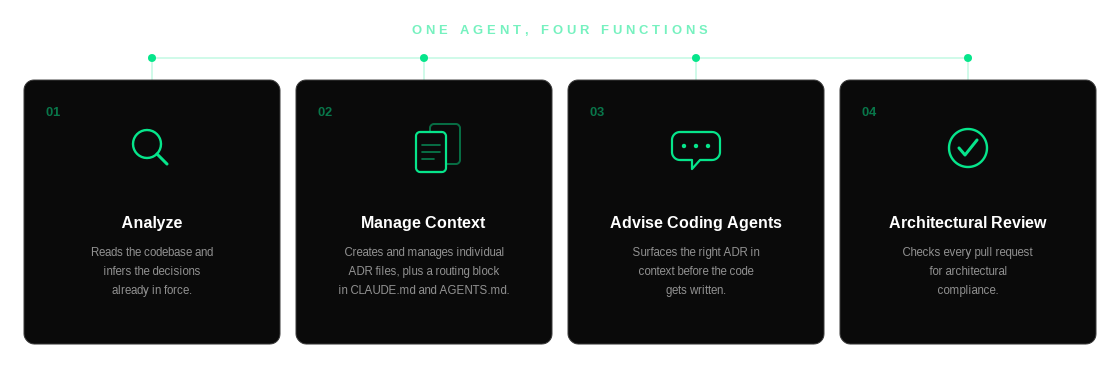
The Architecture Agent's four functions: analyze, manage context, advise coding agents, and architectural review.

Capture decisions without writing docs

Actual AI automatically generates and maintains your architectural decision records based on your codebase patterns and team decisions. Your standards stay documented without anyone stopping to write them, which keeps every team consistent and reduces architectural drift over time.

Keep every agent in sync

Actual AI creates and maintains the individual ADR files that hold your decisions, plus a routing block in claude.md and agents.md that points every agent at them. That keeps your coding agents aligned with the same architectural standards, so each one builds against a single source of truth.

Brief agents as they code

In Claude Code and Codex, the Actual Skill gives a coding agent the rules for a file before it edits it. Your standards show up where the work happens, instead of getting discovered in review.

Catch drift before it ships

Every plan is checked against your decisions before you approve it, and every change before the agent hands back control. A conflict goes back to the agent with the rule it breaks, so violations get caught before they ship.

Frequently asked questions

Teams are using more coding agents and producing code at a volume that's hard to keep up with. When that much code is moving, it gets a lot harder to make sure the output stays high quality and consistent with how your system is actually meant to work. Architecture Decision Records (ADRs) are the guardrails for that. They capture the decisions your team has made about how your codebase should be built, so every change, whether it's written by a person or an agent, can be held to the same standard.
ADRs turn your team's architectural decisions into something every contributor and every coding agent can follow. Instead of relying on tribal knowledge or hoping an agent guesses your conventions, you give it an explicit standard to build against. That keeps quality high even as the volume of AI-generated code grows, and it stops your architecture from drifting over time.
The Architecture Agent is your guardrails for agentic coding. It analyzes your codebase, captures your architectural decisions as ADRs, and keeps every AI coding agent in sync with your standards. It automatically generates and maintains ADRs from your codebase patterns, manages the context files your agents read (like claude.md and agents.md), and checks each plan and change against your decisions to catch violations early.
Most AI code review tools check your code against generic best practices. The Architecture Agent checks it against your team's own architectural decisions. It reads the ADRs for your codebase and checks each plan and change against them, so a change that looks fine on its own still gets caught if it breaks a pattern your team agreed on. Tools like CodeRabbit and Greptile review the diff. The Architecture Agent checks the diff against your architecture.
AI coding agents are fast, but they don't know your team's conventions, so they reintroduce patterns you've already decided against. The Architecture Agent gives every agent the same source of truth. It syncs your ADRs into the context files your agents read, and in Claude Code and Codex it checks each plan and change against them before the agent hands back control. From a terminal or in CI, the same checks run on any diff, whoever wrote it.
Actual AI works with the AI coding tools your team already uses, including Cursor, Claude Code, GitHub Copilot, Windsurf, Cline, Codex, and Aider. It fits into your existing GitHub workflow without changing how you write or ship code.

Ready to transform your engineering team?

Join the growing number of companies using Actual AI to build high-performing teams.